If you only need one line: ChatGPT is the safer all-rounder for daily work, and Grok is the sharper, cheaper specialist for real-time research, video input, and high-volume API workloads. That sentence holds up after months of using both, and the rest of this guide is the honest detail behind it.
The reason this comparison shifted in 2026 is that both products jumped a generation in spring. OpenAI released GPT-5.5 on April 23, 2026. xAI released Grok 4.3 a week later, on April 30. Older articles still benchmarking Grok 4 against GPT-5.2 are working with last season's tools, and the gap they describe is not the one you actually have to choose between today.
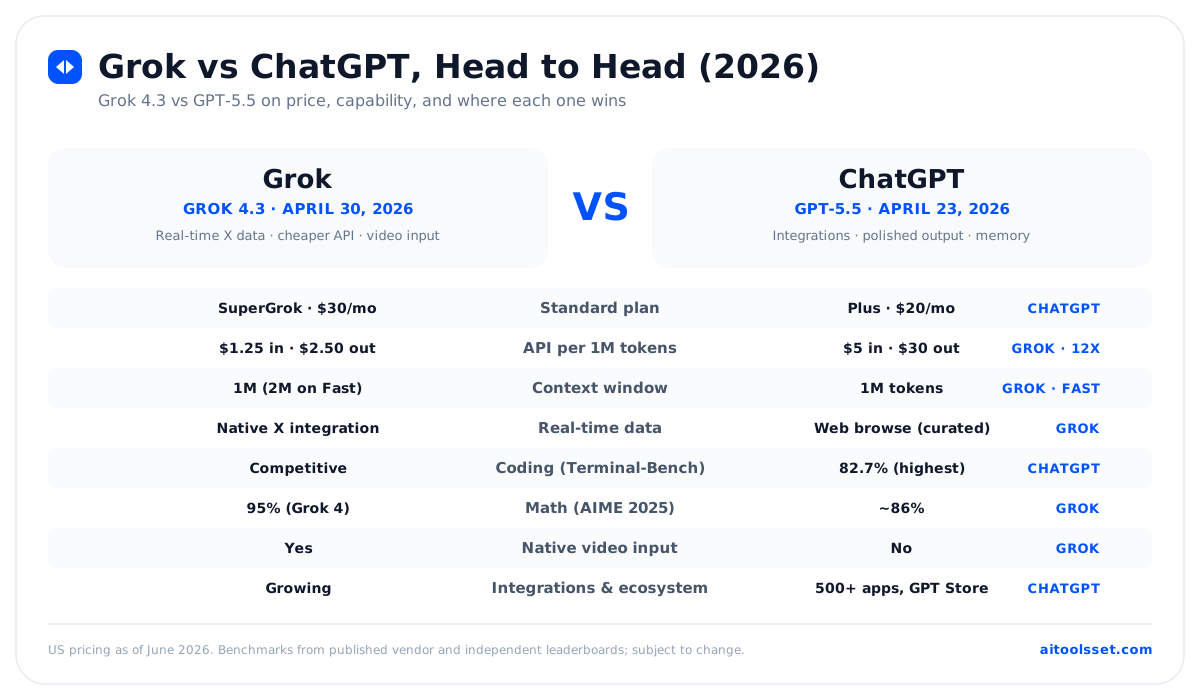
What is the real difference between Grok and ChatGPT?
Strip away the marketing and the two assistants are built on different bets.
ChatGPT is OpenAI's all-purpose assistant. It runs on the GPT-5 family, with GPT-5.5 as the current default and GPT-5.5 Thinking for harder problems. The whole product is tuned for predictable, polished output, deep integrations (Gmail, Slack, GitHub, hundreds of others), persistent memory across sessions, voice, image generation, video through Sora, and a custom GPT store with thousands of community tools. It's the AI your team has probably already approved.
Grok is xAI's bet on a tighter, faster, more direct assistant. It runs on Grok 4.3 today, with a Grok 4 Heavy multi-agent mode on the top tier. The product's two real superpowers are native real-time access to X (formerly Twitter) and a much cheaper API that has put it in serious contention for production workloads. It also tends to push back, joke, and refuse fewer edgy queries than ChatGPT, which some people love and others find unprofessional.
Neither is universally smarter in 2026. The right question is which one fits the work you actually do.
Which models are we actually comparing in 2026?
Getting this part right is half the article, because most older comparisons are benchmarking the wrong versions.
ChatGPT runs on GPT-5.5 as of late April 2026, with GPT-5.5 Thinking for adaptive deep reasoning and GPT-5 Pro on the highest tier. GPT-5.5's context window sits at 1 million tokens.
Grok runs on Grok 4.3 as of April 30, 2026, also with a 1 million token context window in the main app. The faster, cheaper Grok 4 Fast variant extends to 2 million tokens, the largest of any production frontier model. Grok 4 Heavy is the multi-agent swarm mode that runs four cooperating agents (named Grok, Harper, Benjamin, and Lucas) for the hardest tasks; it's only on the top SuperGrok Heavy tier.
That changes a few things from the standard 2025 narrative. The benchmark gap is now narrow enough that picking between them is a workflow question, not a "which is smarter" question.
How much do Grok and ChatGPT cost?
This is where the comparison is most interesting in 2026, because consumer and API pricing tell opposite stories.
Consumer plans
Plan | ChatGPT | Grok |
|---|---|---|
Free | $0 (10 GPT-5.5 messages / 5 hr, then mini) | Limited, requires X account |
Cheap paid | Go: $8 / mo | X Premium: $8 / mo · SuperGrok Lite: $10 / mo |
Standard paid | Plus: $20 / mo | SuperGrok: $30 / mo |
Bundle | Team: $25 / user / mo | X Premium+: $40 / mo |
Power tier | Pro: $100 / mo (5x usage) · Pro Max: $200 / mo (20x, GPT-5 Pro) | SuperGrok Heavy: $300 / mo (Grok 4 Heavy) |
At the consumer level, ChatGPT is the clear value winner. ChatGPT Plus is $20 a month versus SuperGrok at $30, ChatGPT has a free tier and an $8 Go option, and even ChatGPT Pro at $100 is two thirds the price of SuperGrok Heavy.
The one exception: if you're already paying for X Premium+, some Grok access is bundled in, which can shift the math.
API pricing (and why developers are switching)
This is the part Coursiv and most other comparisons miss entirely. The API pricing flipped in April 2026.
Model | Input / output per million tokens |
|---|---|
GPT-5.5 (standard) | $5 / $30 |
Grok 4.3 | $1.25 / $2.50 |
Grok 4 Fast | $0.20 / $0.50 (under 120K input) |
Grok 4.3 is roughly 4x cheaper on input and 12x cheaper on output than GPT-5.5. For a typical mid-size workload of 50 million input tokens and 20 million output tokens a month, GPT-5.5 runs about $850 while Grok 4 Fast comes in around $20. That gap is not a rounding error.
For a casual user, the consumer pricing is what matters and ChatGPT wins on value. For developers shipping production workloads, Grok's API math is now genuinely hard to ignore.
Which one is better for coding?
ChatGPT keeps the production-coding crown, but the lead is narrower than people think.
GPT-5.5 sits at the top of the published agentic coding benchmarks: 82.7% on Terminal-Bench 2.0 and 58.6% on SWE-Bench Pro, both the highest verified scores in the comparison. It also has the deeper ecosystem: GitHub integration, Codex, VS Code and JetBrains plugins, mature multi-file editing, and the broadest set of coding tools developers already use day to day.
Grok 4.3 has closed the gap meaningfully. Independent comparisons put Grok 4 in the same league as GPT-5.4 on SWE-bench (around 75%), and Grok added a real computer it can run code on, install dependencies, and produce actual files from inside the chat. Grok Code Fast 1 is a dedicated coding model with strong scores on algorithmic and competitive problems, and Grok integrates into Cursor, Windsurf, GitHub Copilot, and Cline.
The clean call: ChatGPT for production code, multi-file projects, and any team workflow where predictability matters. Grok for algorithmic exploration, competitive problems, and developers who want a much cheaper API once the workload is in shape.
Which one is better for writing?
This depends on what kind of writing.
For client-ready, professional output (marketing copy, emails, reports, structured long-form), ChatGPT wins. The tone is cleaner, the structure tighter, and Canvas makes iterative drafting genuinely smooth. You finish with a draft that needs less editing.
For creative writing where you want the AI to commit to a voice (fiction, brand voice exploration, edgier copy), Grok pulls ahead. Grok 4.1 set a record on EQ-Bench, an emotional intelligence benchmark, and that shows in the output: it takes positions, swings harder on aesthetic, and hedges less. ChatGPT plays it safer by design.
The honest version is the workflow a lot of writers have settled on: Grok for the first emotionally alive draft, ChatGPT to structure and polish it.
Which one is better for math, science, and reasoning?
Grok still has the edge on raw STEM. Grok 4 hit 95% on AIME 2025 and 87.5% on GPQA, both ahead of OpenAI's published numbers. Grok 4 Heavy was the first model to break 40% on Humanity's Last Exam (44.4%). If you do quant work, optimization problems, or research math, that gap is real.
ChatGPT is the safer pick for multi-step business reasoning, long chains of logic where reliability matters, and any task where consistency beats raw ceiling. Independent testing shows a roughly 12% lower error rate than Grok on long reasoning chains.
Use Grok when you want to push the ceiling. Use ChatGPT when you want a dependable floor.
Which has better real-time and live data?
Grok, by a wide margin and by design.
Grok is wired directly into X. Breaking news, market moves, viral threads, and live event chatter all land in Grok's context the moment they happen, with no scraping or third-party workaround. Its DeepSearch and DeeperSearch modes crawl the web and X simultaneously. For social media managers, journalists, traders, and trend analysts, that integration is the entire reason to pay for it.
ChatGPT browses the web too, but it's more deliberate: it cross-references sources, flags uncertainty, and reads more like a researcher than a feed. Better for accuracy and reporting; slower and more curated than Grok for raw "what is everyone talking about right now."
If your work depends on real-time public conversation, Grok wins this without a fight. For everything else, ChatGPT's browsing is plenty.
Which has the bigger context window?
Both flagships now sit at 1 million tokens on their main models, which is enough to load a full codebase or a book-length document in a single conversation.
The differentiator is Grok 4 Fast, which pushes context to 2 million tokens, the largest of any production frontier model. If your workflow involves very long documents, large codebases, or analyzing massive transcripts in one pass, Grok 4 Fast is the only model that handles it natively.
On the other end, Grok 4.3 also supports native video input, which GPT-5.5 currently does not. For training data analysis, content moderation, or video QA workflows, that single feature is reason enough to consider Grok.
Which one is faster?
Grok is faster on raw throughput. Inference runs at roughly 1,200 tokens per second on optimized hardware, compared to about 900 tps for GPT-5.5 Standard. For simple, chat-style queries, you'll feel that difference.
For complex tasks the picture flips. GPT-5.5 Thinking takes longer by design but produces more reliable output, and Grok 4 Heavy's multi-agent mode adds noticeable overhead. Real-world latency is now more about which mode you pick than which brand you use.
Net: Grok feels snappier on short prompts. Both feel about the same on deep work.
What about safety and content filters?
This is one of the genuine philosophical differences.
ChatGPT refuses roughly 20% more "edgy" queries than Grok, which is exactly what you want in regulated industries (healthcare, legal, education) and exactly what frustrates researchers and creatives who keep getting redirected on legitimate work.
Grok is more permissive, more direct, and more willing to take a position. That's a feature if you want unfiltered engagement and a problem if you need predictable, safe output for client work. Grok's image generation drew real controversy in late 2025 and early 2026 after being misused, and xAI has since restricted image generation to paid subscribers.
Quick rule: ChatGPT for any output that goes in front of a customer, patient, student, or regulator. Grok when you'd rather not be gently redirected on a legitimate question.
Which one should you choose?
Here is the practical decision, written in the way people actually describe themselves. Find the line that sounds like you.
"I want one AI for everyday work and writing"
Get ChatGPT Plus ($20). The integrations, polished output, memory across sessions, and broader feature set make it the safer daily driver. You can be productive on day one.
"I work with social media, news, or live trends"
Get Grok (SuperGrok at $30, or X Premium+ at $40 if you already use X). Native X integration and live web data are genuinely unique. Nothing else comes close for real-time public conversation.
"I'm a developer building at scale"
Use Grok 4.3 or Grok 4 Fast via API. At 4x cheaper input and 12x cheaper output than GPT-5.5, the savings compound fast. Keep a GPT-5.5 fallback for the workloads where you need top tier agentic coding (Terminal-Bench and computer use), and route everything else to Grok. A typical mid-size workload that costs $850 a month on GPT-5.5 lands near $20 on Grok 4 Fast.
"I'm doing serious STEM, math, or research"
Get SuperGrok ($30) or step up to SuperGrok Heavy ($300) if you genuinely need Grok 4 Heavy's multi-agent mode. The AIME, GPQA, and Humanity's Last Exam scores are real, and the gap shows up on actual problems.
"I work in marketing, sales, or client services"
Get ChatGPT Plus. Polished tone, structured output, and Canvas mean less editing. Custom GPTs let you bake in brand voice. This is the lane ChatGPT was designed for.
"I work in a regulated industry"
Get ChatGPT (Plus or Team). Predictable behavior, deeper governance options, lower hallucination on long reasoning chains. Grok's looser filters are the wrong default for compliance-heavy work.
"I want to process long documents or video"
Get Grok. Grok 4 Fast's 2M token context handles huge documents in one pass, and Grok 4.3 is currently the only frontier model with native video input. GPT-5.5 still tops out at 1M context and doesn't process video.
"I want the most personality and the least lecturing"
Get Grok. It refuses less, jokes more, and takes positions. ChatGPT's warmer 5.5 personality has closed some of that gap, but Grok is still the more direct conversationalist.
Rule of thumb: ChatGPT Plus is the default. Pick Grok when you have a specific reason: real-time data, video input, API cost at scale, or a workflow where personality and fewer filters matter more than polish.
A note on privacy and your data
Both products use your conversations to help improve their models by default on consumer tiers, with opt-outs available in settings. Enterprise and business plans typically exclude your data from training by default. If you handle sensitive or client information on either platform, review your data controls before relying on it, and use the business or enterprise tier rather than a personal subscription.
Key takeaways
The current flagships are Grok 4.3 (April 30, 2026) and GPT-5.5 (April 23, 2026). Older comparisons benchmarking Grok 4 against GPT-5.2 are out of date.
ChatGPT Plus at $20 is the default for most users. SuperGrok at $30 is for specific use cases.
Grok's API is 4x cheaper on input and 12x cheaper on output than GPT-5.5, which has made it a serious option for production workloads.
ChatGPT wins coding, polished writing, integrations, memory, and regulated work.
Grok wins real-time X data, STEM benchmarks, raw speed, native video input, and the 2M token Fast context window.
Both context windows are 1M tokens on the main models; only Grok 4 Fast goes to 2M.
Use both for serious work. Most heavy users keep both subscriptions and route by task.
Prices, models, and benchmarks change quickly. Confirm current details before subscribing.
Conclusion
The Grok vs ChatGPT debate isn't about which AI is smarter in 2026. Both flagships are good enough that the choice comes down to fit.
If you want one mature assistant that handles writing, coding, integrations, and business workflows without surprises, ChatGPT Plus at $20 is the default that's hard to beat. If you need real-time X context, native video, raw STEM horsepower, or a serious API cost advantage at scale, Grok 4.3 has earned a real place in the stack.
Start with whichever fits your highest-frequency task, use it daily for a week, and you'll know if you need the other one as a complement rather than a replacement.
Pricing, benchmarks, and model versions reflect publicly available information as of June 2026 and change frequently. Confirm current details on chatgpt.com/pricing and x.ai/grok before subscribing.