If you only need the verdict: Claude Pro at $20 is right for almost everyone. Claude Max 5x at $100 is right when you use Claude Code most of the workday. Claude Max 20x at $200 is right when Claude is genuinely your full-time coworker and you keep hitting weekly limits. That holds up after months of working across all three tiers, and the rest of this guide is the honest detail behind it.
The reason this comparison shifted in 2026 is that Anthropic changed how the plans work twice this spring. On May 6, 2026, the 5-hour rate limits roughly doubled and peak-hour throttling was removed. Then on June 15, 2026, non-interactive usage (Agent SDK, GitHub Actions, automated jobs) moved to a separate monthly credit pool so it no longer competes with your interactive coding sessions. Older Pro vs Max articles citing "45 messages per 5 hours" or describing peak-hour cuts are working with last quarter's numbers.
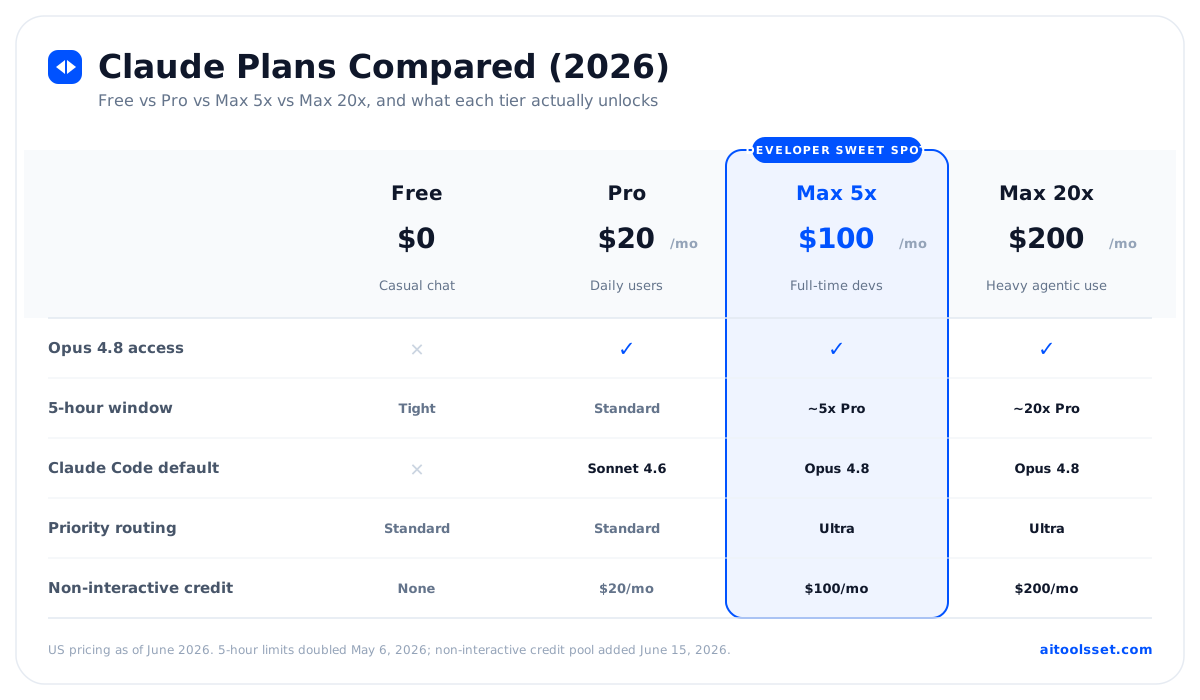
What is the actual difference between Claude Pro and Claude Max?
The blunt version: all three paid tiers run the same models. Whether you pay $20 or $200, you get Claude Opus 4.8 (Anthropic's flagship, released May 28, 2026), Claude Sonnet 4.6, and Claude Haiku 4.5. There is no smarter brain hiding behind the higher price.
What you pay for is capacity, priority, and how much Claude Code you can run before you hit a wall. Max gives you a higher 5-hour limit, separate weekly limits that scale with your tier, ultra-priority routing during peak demand, and earlier access to new models and beta features. That is genuinely useful if you use Claude for serious work, and overkill if you don't.
A quick summary before the detail:
Pro | Max 5x | Max 20x | |
|---|---|---|---|
Price | $20 / mo ($17 annual) | $100 / mo | $200 / mo |
Models | Opus 4.8, Sonnet 4.6, Haiku 4.5 | Same | Same |
5-hour limit | Standard | ~5x Pro | ~20x Pro |
Priority during peak | Standard | Ultra (no queue) | Ultra (no queue) |
Claude Code default model | Sonnet 4.6 | Opus 4.8 | Opus 4.8 |
Non-interactive credit | $20 / month | $100 / month | $200 / month |
Annual discount | Yes (~15%) | Monthly only | Monthly only |
Best for | Daily use, light coding | Full-time devs, 4-6h Claude Code | Heavy Claude Code, 8+ hours daily |
The clean way to decide: count how many hours a day you actually work inside Claude. Under two hours, Pro is plenty. Two to six hours, especially with Claude Code, Max 5x pays for itself. Six plus hours, or you keep hitting weekly limits on 5x, step up to 20x.
What is Claude Pro and who is it for?
Claude Pro is the $20-a-month plan most people land on, and for good reason. It removes the strict caps on the free tier, unlocks the full model lineup including Opus 4.8, includes Claude Code (the terminal-based coding agent), and gives you Projects to organize files and instructions across chats.
Pro runs Sonnet 4.6 as the default model in Claude Code, with Opus 4.8 selectable when you need deeper reasoning. The standard 5-hour rolling window is plenty for daily work: drafting, document analysis, light coding, research, and most of what people actually use Claude for.
Pro is the right plan for:
Writers and content people drafting, editing, and summarizing daily
Students doing research and analysis
Marketers, analysts, and consultants using Claude as a thinking partner
Developers who code with Claude occasionally rather than constantly
Anyone whose use is "an hour here, an hour there" rather than full days
If you can describe your usage as "I open Claude a few times a day," Pro is the answer. The annual plan at $17 a month (roughly 15% off) is worth it once you've used Pro for three months and know you're sticking with it.
What is Claude Max and why does it exist?
Anthropic launched Claude Max because their heaviest users, mostly developers using Claude Code on real production work, were hitting their 5-hour limits before lunch. Max wasn't designed to add features; it was designed to remove the leash.
Max comes in two flavors. Max 5x at $100/month gives you roughly five times the Pro 5-hour allowance, defaults Claude Code to Opus 4.8, and includes ultra-priority routing so you don't get queued behind everyone else during peak hours. Max 20x at $200/month gives you twenty times the Pro allowance, the highest weekly limits, and the experience that's closest to "unlimited" for any single human.
Max also gets earlier access to new models, beta features like dynamic workflows in Claude Code, and experimental tools as they roll out. You're not paying for different intelligence. You're paying for the freedom to use Claude as much as you actually need to without rate-counting in your head.
How much do Claude Pro and Max cost?
Plan | Monthly | Annual (per month) | Best for |
|---|---|---|---|
Free | $0 | N/A | Trying Claude, casual chat |
Pro | $20 | $17 ($200 billed yearly) | Daily users, light coding |
Max 5x | $100 | Monthly only | Full-time professional use |
Max 20x | $200 | Monthly only | Heavy agentic coding workloads |
Team Standard | $25 / seat | $20 / seat | Small teams, Sonnet default |
Team Premium | $150 / seat | — | Teams needing Opus default |
Enterprise | Custom (~$60+ / seat, 70+ users) | Custom | Large orgs with SSO and compliance |
A few things worth knowing before you pick:
The 15% annual discount only applies to Pro, not Max. Max 5x and Max 20x are month-to-month. That actually works in your favor since most people don't stay on Max year-round; it's the plan you flip to during heavy build cycles and back off during quieter months.
If you're working in a team of two or more, Team Standard at $25 per seat ($20 annual) is often a better deal than individual Pro accounts because it pools usage across the team and adds admin controls. Team Premium runs Opus 4.8 by default in Claude Code, which is closer to the Max experience at a per-seat price.
Enterprise typically starts around $60 per seat with a 70 user minimum and is negotiated. Unless you're at that scale, ignore it.
How do Claude's 5-hour and weekly limits actually work in 2026?
This is the part most articles get wrong because Anthropic changed it twice this year. Here's the current reality.
Claude runs on two stacked limits: a rolling 5-hour session window and a weekly cap that sits on top of it. You can hit either one independently, and either one blocks you until it resets.
The 5-hour window doubled on May 6, 2026. Anthropic added compute (a SpaceX deal that brought roughly 300 megawatts and 220,000+ NVIDIA GPUs online at Colossus 1) and used it to roughly double the per-window allowance while removing the old peak-hour reductions. Articles citing "~45 messages per 5 hours" on Pro or "reduced limits during 5-11 AM PT" are pre-May 2026 numbers. The new floor is higher and consistent across the day.
Weekly limits sit on top of the session limit. Max plans carry two weekly limits: one across all models and a second specifically for Sonnet. A heavy weekend can leave you session-capped on Monday with weekly headroom, or weekly-capped with session capacity to spare. You can see both reset times in Settings > Usage on claude.ai or with /usage inside Claude Code.
The "messages per window" number is fuzzy by design. Anthropic does not publish exact counts because complex prompts cost dramatically more than simple ones. A "hello" uses almost nothing; "refactor this 20 file repo" can eat the equivalent of 10 to 15 standard messages in a single prompt. Practical takeaway: focus on how often you hit limits in a week, not on counting prompts.
For Claude Code users specifically, Anthropic's published "hours of work" estimates are more useful than message counts: Pro gives roughly 40 to 80 active hours per week on Sonnet, Max 5x extends that toward 200+ hours, and Max 20x reaches close to 500 Sonnet hours or 40+ Opus hours weekly depending on complexity.
What changed for automated and non-interactive usage in June 2026?
This is the other 2026 change competitor articles miss, and it matters a lot if you run any automation on top of Claude.
Starting June 15, 2026, non-interactive usage moved to a separate monthly credit pool. The Agent SDK, the claude -p command, the GitHub Actions integration, and any third-party app that authenticates with your subscription now draw from a dedicated monthly budget:
Pro: $20 per month in non-interactive credit
Max 5x: $100 per month in non-interactive credit
Max 20x: $200 per month in non-interactive credit
The practical effect is that CI jobs, scheduled agents, and background scripts no longer eat the 5-hour window you need for your own coding work. That's a real quality of life win. The catch is that the non-interactive credit has its own hard monthly ceiling and doesn't roll over. When it runs out, requests either flow to API rates (if you've enabled usage credits) or stop entirely.
If you run a meaningful amount of automation against Claude, this single change makes Max more attractive than the headline price suggests, because $100 of Max 5x non-interactive credit roughly matches a small API account on its own.
Is Claude Max better for coding and developers?
For most developers who actually use Claude Code daily, the answer is yes, and the math is more obvious than it looks.
Claude Code is the terminal-based agent that lives in your IDE or terminal. It reads your codebase, plans tasks, executes changes, and handles multi-file work. It's the single most token-hungry workflow Anthropic offers, because every prompt has to include or re-read significant context.
On Pro, Claude Code defaults to Sonnet 4.6 with the standard 5-hour limit. Fine for one to two hour daily coding sessions, occasional debugging, and small tasks. You will hit walls if you try to refactor across many files or run long agentic loops.
On Max 5x, Claude Code defaults to Opus 4.8 (the stronger reasoning model), with roughly 5x the session capacity. This is the tier where developers stop counting prompts. You can let an agent run a loop to fix bugs, run tests, and iterate without "saving up" your quota for later. For full-time devs, this almost always pays for itself in saved time and avoided context-switching.
On Max 20x, you're essentially paying for the "never see a limit screen" experience. Repository-wide refactors, multi-hour architecture reviews, and the new dynamic workflows feature (which runs hundreds of parallel subagents under your direction) work without the mental tax of rationing.
The deciding question for developers: how often do you currently hit a usage limit on Pro? If the answer is "once or twice a week," stay on Pro. If it's "every afternoon," Max 5x will pay back the $80 difference in saved time within the first week. If you exhaust Max 5x weekly limits regularly, that's the signal to consider 20x.
Is Claude Max cheaper than using the Anthropic API directly?
For sustained daily coding work, almost always yes. For light or bursty use, the API is cheaper.
The Anthropic API charges per token: Opus 4.8 at $5 input / $25 output per million tokens, Sonnet 4.6 at $3 / $15. A heavy day of agentic Claude Code work can run $15 to $40 in API charges because each tool call drags in context. Twenty workdays a month of that adds up fast.
Here's the rough math for a developer using Claude Code six hours a day:
Max 5x | API direct | |
|---|---|---|
Monthly cost | $100 (fixed) | $300 to $800 (varies) |
Predictability | Locked | High variance |
Cost ceiling | Yes, by design | None; runaway scripts can spike |
Interface | Claude.ai + Claude Code | Terminal, third-party IDEs |
Caching | Automatic in app | You configure it |
Best for | Sustained daily use | Occasional, light, or scripted use |
A reliable rule: if you'd be using Claude Code for more than two hours a day most weekdays, Max 5x is cheaper and more predictable than pay-as-you-go API. If your use is occasional, bursty, or running through automation only, the API tends to win.
The exception is if you're building a product that calls Claude programmatically. Subscription plans are for human use; production traffic should go through the API with proper monitoring and prompt caching, which can cut your costs by up to 90% on repeated context.
Which features are actually exclusive to Max?
Strictly speaking, very few. Most of Claude's headline features (Projects, Artifacts, Claude Code, MCP connectors, file uploads, voice mode) work on both Pro and Max. The "Max exclusives" are mostly about volume and access rather than locked features.
What Max actually gives you that Pro doesn't:
Ultra-priority routing. During heavy demand, Max requests skip the queue. You feel this most around launches and morning peaks (roughly 5 to 11 AM Pacific).
Higher weekly Sonnet and Opus limits. Pro has effectively one limit; Max layers a higher weekly cap on top so heavy weeks don't end your Tuesday.
Opus 4.8 as the Claude Code default. You can manually switch on Pro, but it eats your quota faster. On Max, Opus is the default and your runway absorbs it.
Dynamic workflows in Claude Code (research preview, Max and Team plans). Plans a task and runs hundreds of parallel subagents under your direction. Excellent for large-scale codebase work and not yet available on Pro.
Earlier access to new models and beta features. When Opus 4.7 and 4.8 rolled out, Max users saw them first. Same for voice mode, advanced MCP features, and computer use research previews.
Higher non-interactive credit ($100 on Max 5x, $200 on Max 20x, vs $20 on Pro), which matters for anyone running automation.
If none of those describe your workflow, you don't need Max. If two or more sound like you, the upgrade pays back.
Which Claude plan should you choose?
The decision is almost entirely about your real usage, written in the way people actually describe themselves.
"I use Claude a few times a day for writing and research"
Stay on Pro ($20). Opus 4.8 is available when you need it, the limits won't bother you, and the annual plan at $17/month is the best AI value going if you commit for the year.
"I'm a marketer, consultant, or creator"
Pro. You'll burn through quota with long Projects and big PDFs occasionally, but not enough to justify $100. Use Projects to keep brand context and instructions organized so each chat doesn't have to relearn your business.
"I code with Claude two to six hours a day"
Get Max 5x ($100). This is the upgrade most full-time developers need. Opus 4.8 as the Claude Code default, ultra priority, no peak-hour throttling, $100 of separate non-interactive credit for your CI and scripts. You'll stop thinking about quotas within a week.
"I'm a freelance developer or solo founder shipping daily"
Max 5x. The $80 difference vs Pro buys you uninterrupted flow state, which is the single biggest productivity multiplier when you charge for your time. If you bill clients hourly, it pays itself back in the first saved interruption.
"I run automated agents or CI jobs on Claude"
At minimum Pro for the $20 monthly non-interactive credit, but Max 5x if your automation is more than a hobby. The June 15 credit split means automation no longer competes with your interactive sessions, but the budget is hard, so size your plan to your automation, not just your chat use.
"Claude is my full-time coding partner, 6+ hours daily"
Max 20x ($200). You're the user this tier exists for. Massive refactors, dynamic workflows with parallel subagents, long architecture sessions, and the closest thing to "unlimited" you can get on a personal plan. If you're regularly hitting weekly caps on Max 5x, that's the signal to step up.
"I run a small team that all uses Claude"
Look at Team Standard ($25/seat, $20 annual) instead of individual Pro accounts. You get pooled usage, admin controls, and shared Projects. Team Premium runs Opus 4.8 by default in Claude Code if your team is dev-heavy.
"I'm not sure which one to pick"
Start on Pro for a month. Open Settings > Usage at the end of each week and count how many times you hit a limit. Zero to one hits: stay. Three or more hits, especially in Claude Code: upgrade to Max 5x. Easy.
Rule of thumb: the cheapest plan that removes your actual bottleneck is the right one. Upgrade when you feel the limit, not before.
How do you upgrade or downgrade between plans?
Upgrading is one click. Log in to claude.ai, click your profile (bottom left), go to Settings > Billing, and pick the new tier. Anthropic prorates your remaining Pro balance toward the new plan, so you're not double-paying for the month. New limits take effect almost immediately, which means if you hit a Pro wall mid-day, upgrading is the fastest way to keep working without waiting for the 5-hour reset.
Annual Pro upgrading to Max: the remaining value of your annual subscription typically converts to credit against the first months of Max, so you may not see a card charge for a billing cycle or two.
Downgrading from Max back to Pro is safe. Your Projects, chat history, custom instructions, uploaded files, and MCP connectors are tied to your account, not your tier. Drop to Pro and you keep everything you've built; the only change is your monthly capacity. Useful if you want Max during a build cycle and Pro the rest of the year.
A note on data, privacy, and Claude's defaults
On personal plans (Free, Pro, Max), Anthropic does not use your conversations to train models by default. Team and Enterprise plans extend this with admin controls, SSO, and audit logging. If you're handling sensitive client work or proprietary code, Team or Enterprise is the right tier regardless of your usage volume, because the governance, not just the limits, is what you're paying for.
Key takeaways
All paid Claude plans run the same models: Opus 4.8, Sonnet 4.6, Haiku 4.5. You're paying for volume and priority, not intelligence.
Pro at $20 is enough for most people, including most writers, marketers, and light coders. The $17 annual plan is the best value.
Max 5x at $100 is the developer sweet spot if you use Claude Code two to six hours a day. Opus 4.8 default, ultra priority, $100 non-interactive credit.
Max 20x at $200 is for heavy agentic workloads, repeated weekly limit hits, and 6+ hour daily use. Most people don't need it.
The 5-hour limits doubled on May 6, 2026 and peak-hour throttling is gone. Older Pro vs Max articles are outdated on this.
Non-interactive usage moved to a separate monthly credit on June 15, 2026 ($20 / $100 / $200 by tier), so automation no longer competes with your chats.
Use the right yardstick: count limit-hits per week, not messages per day.
Prices, limits, and features change frequently. Confirm current details before subscribing.
Conclusion
Claude Pro vs Max is not a question of which version is better. They run the same models and offer the same core features. The question is how much Claude you actually use, and whether the time you lose to rate limits is worth $80 or $180 a month to remove.
If you open Claude a few times a day, Pro at $20 is the right answer and will be for a long time. If Claude Code is sitting next to your IDE most of the workday, Max 5x at $100 removes the friction and tends to pay for itself in saved interruptions within the first week. And if you genuinely live inside Claude for entire workdays and your work is the kind that compounds when uninterrupted, Max 20x at $200 is the only tier that gets out of your way.
Pick the cheapest plan that removes your bottleneck. Watch Settings > Usage for a month. Let your actual usage tell you when it's time to move up.
Pricing, limits, and features reflect publicly available information as of late June 2026 and change frequently. Confirm current details on claude.ai/pricing and Anthropic's documentation before subscribing.